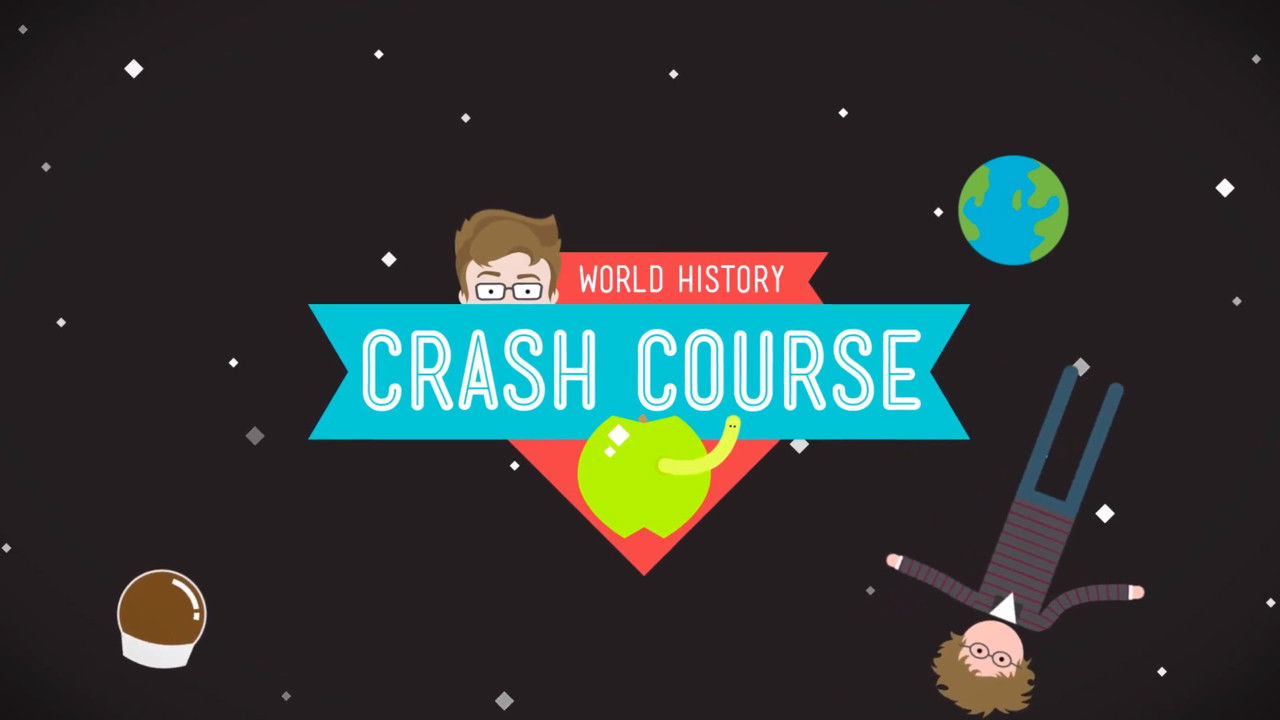
Crash Course

Crash Course

John Green teaches you the history of the world

Ended First aired 05/Aug/2022 India Hindi 2 season(s) 72 episode(s)
Crash Course World History is a video course hosted by John Green that teaches world history from growing the first crops in the First Agricultural Revolution to global textile production in the 2010s. Across the series, it builds skills in identifying and explaining historical developments, analyzing events in broader context, and tracing patterns and connections across time and place—aiming to help viewers become more informed citizens of the world. Season 1 follows the 2012 AP World History curriculum in a 42-episode chronological survey, while Season 2 continues in 30 episodes with a more thematic approach that focuses on systems and encourages viewers to question how “history” is written and what biases shape it.

Episode Time in Your Timezone

See when new episodes air in your local time.

Air Time

Source: UTC · Your timezone: America/New_York

When does the episode air near you?

The local release time is not available yet because this show has no schedule time.


Notice: Schedule time is not available yet.

Show Insights

See how viewers feel about this show before you start watching.

TimeScore 33% Skip It
Binge Meter 48% Slow Burn
Episode Pulse Quiet 40% activity score
Drop Rate 0% Very Low

Scores are based on audience votes, watchlist activity, episode progress, and viewer behavior on EpisodeTime.

Seasons & Episodes

Browse episodes by season.

Season 2 · Season 2 - World History 2
30 episode(s) · Air date: 11/Jul/2014
Improve Season
Season Overview

In 30 episodes, John Green rethinks world history! In round two we take a different approach and try to think more thematically rather than chronologically. By the end of the course, you will be able to: *Think about history thematically and in terms of systems, not just important events *Analyze the context of historical events, developments, and processes and explain how they are situated within a broader historical context *Explain the importance of point of view, historical situation, and audience of a source *Question how what we think of as “history,” how it is written, and what biases are at play in a work

Season Overview

In 30 episodes, John Green rethinks world history! In round two we take a different approach and try to think more thematically rather than chronologically. By the end of the course, you will be able to: *Think about history thematically and in terms of systems, not just important events *Analyze the context of historical events, developments, and processes and explain how they are situated within a broader historical context *Explain the importance of point of view, historical situation, and audience of a source *Question how what we think of as “history,” how it is written, and what biases are at play in a work

S2E30
Democracy, Authoritarian Capitalism, and China: Crash Course World History 230
Air date: 04/Apr/2015 · Runtime: 15 min
Summary

John Green teaches you about the end of World History, and the end of the world as we know it, kind of. For the last hundred years or so, it seemed that one important ingredient for running an economically successful country was a western-style democratic government. All evidence pointed to the idea that capitalist representative democracies made for the best economic outcomes. It turns out that isn't the only way to succeed. In the last 40 years or so, authoritarian capitalism as it's practiced in places like China and Singapore has been working really, really well. John is going to look at these systems and talk about why they work, and he's even going to make a few predictions about the future. Also, thanks for watching this series. It has been amazingly fun to create, and we appreciate all of you.

Summary

John Green teaches you about the end of World History, and the end of the world as we know it, kind of. For the last hundred years or so, it seemed that one important ingredient for running an economically successful country was a western-style democratic government. All evidence pointed to the idea that capitalist representative democracies made for the best economic outcomes. It turns out that isn't the only way to succeed. In the last 40 years or so, authoritarian capitalism as it's practiced in places like China and Singapore has been working really, really well. John is going to look at these systems and talk about why they work, and he's even going to make a few predictions about the future. Also, thanks for watching this series. It has been amazingly fun to create, and we appreciate all of you.

S2E29
Capitalism and the Dutch East India Company: Crash Course World History 229
Air date: 18/Mar/2015 · Runtime: 15 min
Summary

John Green teaches you about the Vereenigde Oostindische Compagnie, doing business as the VOC, also known as the Dutch East India Company. In the 16th and 17th centuries, the Dutch managed to dominate world trade, and they did all through the pioneering use of corporations and finance. Well, they did also use some traditional methods like violently enforced monopolies, unfair trade agreements, and plain old warfare. You'll learn how the Dutch invented stuff like joint stock corporations, maritime insurance, and futures trading. Basically, how the Dutch East India Company crashed the US economy in 2008. I'm kidding. Or am I?

Summary

John Green teaches you about the Vereenigde Oostindische Compagnie, doing business as the VOC, also known as the Dutch East India Company. In the 16th and 17th centuries, the Dutch managed to dominate world trade, and they did all through the pioneering use of corporations and finance. Well, they did also use some traditional methods like violently enforced monopolies, unfair trade agreements, and plain old warfare. You'll learn how the Dutch invented stuff like joint stock corporations, maritime insurance, and futures trading. Basically, how the Dutch East India Company crashed the US economy in 2008. I'm kidding. Or am I?

S2E28
Nonviolence and Peace Movements: Crash Course World History 228
Air date: 13/Mar/2015 · Runtime: 12 min
Summary

John Green teaches you about nonviolence and peace movements in the 20th century. What is nonviolence? What is a peace movement? Well. traditionally, humans often resort to violence when they come into conflict. In the 20th century, it became much more common for people to enact change by means of nonviolence, and there was a common thread of connection between many of the most notable advocates of peaceful change. Crash Course will take you from Gandhi to Gregg to Bayard Rustin to Martin Luther King, Jr, to the Cold War to Arab Spring along a path of nonviolent resistance and peaceful change. It's pretty great.

Summary

John Green teaches you about nonviolence and peace movements in the 20th century. What is nonviolence? What is a peace movement? Well. traditionally, humans often resort to violence when they come into conflict. In the 20th century, it became much more common for people to enact change by means of nonviolence, and there was a common thread of connection between many of the most notable advocates of peaceful change. Crash Course will take you from Gandhi to Gregg to Bayard Rustin to Martin Luther King, Jr, to the Cold War to Arab Spring along a path of nonviolent resistance and peaceful change. It's pretty great.

S2E27
Japan in the Heian Period and Cultural History: Crash Course World History 227
Air date: 04/Mar/2015 · Runtime: 13 min
Summary

John Green teaches you about what westerners call the middle ages and the lives of the aristocracy...in Japan. The Heian period in Japan lasted from 794CE to 1185CE, and it was an interesting time in Japan. Rather than being known for a thriving economy, or particularly interesting politics, the most important things to come out of the Heian period were largely cultural. There was a flourishing of art and literature in the period, and a lot of that culture was created by women. The Tale of Genji by Murasaki Shikibu was the classic piece of literature of the day, and it gave a detailed look into the way the Aristocrats of the Heian period lived. While this doesn't give a lot of insight into the lives of daily people, it can be very valuable, and the idea of approaching history from a cultural perspective is a refreshing change from the usual military or political history that survives from so many eras.

Summary

John Green teaches you about what westerners call the middle ages and the lives of the aristocracy...in Japan. The Heian period in Japan lasted from 794CE to 1185CE, and it was an interesting time in Japan. Rather than being known for a thriving economy, or particularly interesting politics, the most important things to come out of the Heian period were largely cultural. There was a flourishing of art and literature in the period, and a lot of that culture was created by women. The Tale of Genji by Murasaki Shikibu was the classic piece of literature of the day, and it gave a detailed look into the way the Aristocrats of the Heian period lived. While this doesn't give a lot of insight into the lives of daily people, it can be very valuable, and the idea of approaching history from a cultural perspective is a refreshing change from the usual military or political history that survives from so many eras.

S2E26
Iran's Revolutions: Crash Course World History 226
Air date: 26/Feb/2015 · Runtime: 13 min
Summary

John Green teaches you about Iran's Revolutions. Yes, revolutions plural. What was the the1979 Iranian Revolution about? It turns out that Iran has a pretty long history of unrest in order to put power in the hands of the people, and the most recent revolution in 1979 was, at least at first, not necessarily about creating an Islamic state. It certainly turned out to be about that, but it was initially just about people who wanted to get rid of an oppressive regime. Listen up as John teaches you about Iran's long history of revolution.

Summary

John Green teaches you about Iran's Revolutions. Yes, revolutions plural. What was the the1979 Iranian Revolution about? It turns out that Iran has a pretty long history of unrest in order to put power in the hands of the people, and the most recent revolution in 1979 was, at least at first, not necessarily about creating an Islamic state. It certainly turned out to be about that, but it was initially just about people who wanted to get rid of an oppressive regime. Listen up as John teaches you about Iran's long history of revolution.

S2E25
War and Nation Building in Latin America: Crash Course World History 225
Air date: 11/Feb/2015 · Runtime: 12 min
Summary

John Green teaches you about nation-building and nationalism in Latin America. Sometimes, the nations of Latin America get compared to the nations of Europe and are found wanting. This is kind of a silly comparison. The rise of democratic, economically powerful nations in Europe came about under a very different set of circumstances than the way nations arose in Latin America, so the regions are necessarily a lot different. But why? John will explore whether it was a lack of international war which impeded Latin America's growth, which sounds like a crazy thing to say, but you should hear him out.

Summary

John Green teaches you about nation-building and nationalism in Latin America. Sometimes, the nations of Latin America get compared to the nations of Europe and are found wanting. This is kind of a silly comparison. The rise of democratic, economically powerful nations in Europe came about under a very different set of circumstances than the way nations arose in Latin America, so the regions are necessarily a lot different. But why? John will explore whether it was a lack of international war which impeded Latin America's growth, which sounds like a crazy thing to say, but you should hear him out.

S2E24
The Vikings! — Crash Course World History 224
Air date: 04/Feb/2015 · Runtime: 11 min
Summary

John Green teaches you about Vikings! That's right, one of our most requested subjects, the Vikings, right here on Crash Course. So what's the deal with Vikings? Well, the stuff you've heard about them may not be true. The Vikings weren't just pagan raiders striking terror into the hearts of defenseless European Christendom. They were some of the greatest travelers of their time, and they weren't always traveling to steal. In a lot of cases, they were traveling to trade. John will teach you about Viking trade goods, Norse Mythology, and yes, there will be blood, guts, and dragons. OK?

Summary

John Green teaches you about Vikings! That's right, one of our most requested subjects, the Vikings, right here on Crash Course. So what's the deal with Vikings? Well, the stuff you've heard about them may not be true. The Vikings weren't just pagan raiders striking terror into the hearts of defenseless European Christendom. They were some of the greatest travelers of their time, and they weren't always traveling to steal. In a lot of cases, they were traveling to trade. John will teach you about Viking trade goods, Norse Mythology, and yes, there will be blood, guts, and dragons. OK?

S2E23
Conflict in Israel and Palestine through 2015: Crash Course World History 223
Air date: 28/Jan/2015 · Runtime: 12 min
Summary

John Green teaches you about the conflict in Israel and Palestine. This conflict is often cast as a long-term beef going back thousands of years, rooted in a clash between religions. Well, that's not quite true. What is true is that the conflict is immensely complicated, and just about everyone in the world has an opinion about it. John is going to try to get the facts across in under 13 minutes.

Summary

John Green teaches you about the conflict in Israel and Palestine. This conflict is often cast as a long-term beef going back thousands of years, rooted in a clash between religions. Well, that's not quite true. What is true is that the conflict is immensely complicated, and just about everyone in the world has an opinion about it. John is going to try to get the facts across in under 13 minutes.

S2E22
Water and Classical Civilizations: Crash Course World History 222
Air date: 21/Jan/2015 · Runtime: 11 min
Summary

John Green teaches you about water! So, we talk about resources a lot on Crash Course, and today is no exception. It turns out people can't live without water, which means it's absolutely necessary for civilization. Today John talks about water in the context of classical civilizations, but not like Greece or Rome or something. We're talking about the Maya civilization in Central America, and the Khmer civilization in what is now Cambodia. So this is an awesome video, OK?

Summary

John Green teaches you about water! So, we talk about resources a lot on Crash Course, and today is no exception. It turns out people can't live without water, which means it's absolutely necessary for civilization. Today John talks about water in the context of classical civilizations, but not like Greece or Rome or something. We're talking about the Maya civilization in Central America, and the Khmer civilization in what is now Cambodia. So this is an awesome video, OK?

S2E21
Congo and Africa's World War: Crash Course World History 221
Air date: 16/Jan/2015 · Runtime: 12 min
Summary

John Green teaches you about the Democratic Republic of the Congo, which used to be Zaire, which used to be The Belgian Congo, which used to be the Congo Free State, which used to be the region surrounding the Congo River Basin in central Africa. So the history of this place is a little convoluted. The history of Congo is central to the history of central Africa, and the Congo Wars embroiled neighboring countries like Uganda and Rwanda. John will talk you through the history of Congo and the region.

Summary

John Green teaches you about the Democratic Republic of the Congo, which used to be Zaire, which used to be The Belgian Congo, which used to be the Congo Free State, which used to be the region surrounding the Congo River Basin in central Africa. So the history of this place is a little convoluted. The history of Congo is central to the history of central Africa, and the Congo Wars embroiled neighboring countries like Uganda and Rwanda. John will talk you through the history of Congo and the region.

S2E20
World War II, A War for Resources: Crash Course World History 220
Air date: 14/Dec/2014 · Runtime: 11 min
Summary

John Green teaches you about World War II, and some of the causes behind the war. In a lot of ways, WWII was about resources, especially food. The expansionist aggression of both Germany and Japan was in a lot of ways about resources. There were other reasons, to be sure, but the idea that the Axis needed more food can't be ignored.

Summary

John Green teaches you about World War II, and some of the causes behind the war. In a lot of ways, WWII was about resources, especially food. The expansionist aggression of both Germany and Japan was in a lot of ways about resources. There were other reasons, to be sure, but the idea that the Axis needed more food can't be ignored.

S2E19
Charles V and the Holy Roman Empire: Crash Course World History 219
Air date: 05/Dec/2014 · Runtime: 13 min
Summary

John Green teaches you about the Holy Roman Empire by teaching you about Charles V. Charles Hapsburg was the Holy Roman Emperor, but he was also the King of Spain. And the King of Germany. And the King of Italy and the Lord of the Netherlands and Count Palatine of Burgundy. In short, Charles was runnin' thangs in much of the world during his reign. Charles ruled a lot of countries, and he was also known for encouraging intellectual discourse and even spoke out against slavery, in a limited way. So why did he consider himself a failure, and why did he break up the Empire when he abdicated in 1556? Mainly because the Holy Roman Empire didn't work very well. It was huge, and it didn't have any means of directly raising taxes. Plus, it was a pretty crazy time in Europe anyway, and Charles found himself in charge of the Catholic-Church-Endorsed Empire during the time of Martin Luther and the Protestant Reformation.

Summary

John Green teaches you about the Holy Roman Empire by teaching you about Charles V. Charles Hapsburg was the Holy Roman Emperor, but he was also the King of Spain. And the King of Germany. And the King of Italy and the Lord of the Netherlands and Count Palatine of Burgundy. In short, Charles was runnin' thangs in much of the world during his reign. Charles ruled a lot of countries, and he was also known for encouraging intellectual discourse and even spoke out against slavery, in a limited way. So why did he consider himself a failure, and why did he break up the Empire when he abdicated in 1556? Mainly because the Holy Roman Empire didn't work very well. It was huge, and it didn't have any means of directly raising taxes. Plus, it was a pretty crazy time in Europe anyway, and Charles found himself in charge of the Catholic-Church-Endorsed Empire during the time of Martin Luther and the Protestant Reformation.

S2E18
Luther and the Protestant Reformation: Crash Course World History 218
Air date: 29/Nov/2014 · Runtime: 15 min
Summary

John Green teaches you about the Protestant Reformation. Prior to the Protestant Reformation, pretty much everyone in Europe was a Roman Catholic. Not to get all "great man," but Martin Luther changed all that. Martin Luther didn't like the corruption he saw in the church, especially the sale of indulgences, so he left the church and started his own. And it caught on! And it really did kind of change the world. The changes increased literacy and education, and some even say the Protestant Reformation was the beginning of Capitalism in Europe.

Summary

John Green teaches you about the Protestant Reformation. Prior to the Protestant Reformation, pretty much everyone in Europe was a Roman Catholic. Not to get all "great man," but Martin Luther changed all that. Martin Luther didn't like the corruption he saw in the church, especially the sale of indulgences, so he left the church and started his own. And it caught on! And it really did kind of change the world. The changes increased literacy and education, and some even say the Protestant Reformation was the beginning of Capitalism in Europe.

S2E17
The Mughal Empire and Historical Reputation: Crash Course World History 217
Air date: 21/Nov/2014 · Runtime: 11 min
Summary

John Green teaches you about the Mughal Empire, which ruled large swaths of the Indian Sub-Continent from 1526 to (technically) 1857. While John teaches you about this long-lived Muslim empire, he'll also look at the idea of historical reputation and how we view people from history. Namely, he'll look at the reputations of Mughal emperors Akbar I and Aurangzeb. Traditionally, Akbar I is considered the emperor that made the Mughal Empire great, and Aurangzeb gets the blame for running the whole thing into the ground and setting it up for decline. Is that really how it was, though? It turns out, it's complicated.

Summary

John Green teaches you about the Mughal Empire, which ruled large swaths of the Indian Sub-Continent from 1526 to (technically) 1857. While John teaches you about this long-lived Muslim empire, he'll also look at the idea of historical reputation and how we view people from history. Namely, he'll look at the reputations of Mughal emperors Akbar I and Aurangzeb. Traditionally, Akbar I is considered the emperor that made the Mughal Empire great, and Aurangzeb gets the blame for running the whole thing into the ground and setting it up for decline. Is that really how it was, though? It turns out, it's complicated.

S2E16
Islam and Politics: Crash Course World History 216
Air date: 14/Nov/2014 · Runtime: 13 min
Summary

John Green teaches you about how Islam has interacted with politics during its history, and how it continues to do so today. Islamist movements are in the news a lot lately, but how did that happen. John will point out that Islam has always been tied to political movements. Mohammed was not only a religious leader, he led an empire. So how did this lead to modern movements like ISIS? Islam has traditionally been a pretty egalitarian religion, and its scriptures value peace, so it is surprising in a lot of ways that such a violent fundamentalist movement would come out of it. What is a caliphate? What is a Caliph? John will teach you all about it. Take it easy in the comments, y'all. Be kind and respectful to each other.

Summary

John Green teaches you about how Islam has interacted with politics during its history, and how it continues to do so today. Islamist movements are in the news a lot lately, but how did that happen. John will point out that Islam has always been tied to political movements. Mohammed was not only a religious leader, he led an empire. So how did this lead to modern movements like ISIS? Islam has traditionally been a pretty egalitarian religion, and its scriptures value peace, so it is surprising in a lot of ways that such a violent fundamentalist movement would come out of it. What is a caliphate? What is a Caliph? John will teach you all about it. Take it easy in the comments, y'all. Be kind and respectful to each other.

S2E15
Population, Sustainability, and Malthus: Crash Course World History 215
Air date: 07/Nov/2014 · Runtime: 12 min
Summary

John Green teaches you about population. So, how many people can reasonably live on the Earth? Thomas Malthus got it totally wrong in the 19th century, but for some reason, he keeps coming up when we talk about population. In 1800, the human population of the Earth passed 1 billion, and Thomas Malthus posited that growth had hit its ceiling, and the population would level off and stop growing. He was totally right. Just kidding, he was totally wrong! There are like 7 billion people on the planet now! John will teach a little about how Malthus made his calculations, and explain how Malthus came up with the wrong answer. As is often the case, it has to do with making projections based on faulty assumptions. Man, people do that a lot.

Summary

John Green teaches you about population. So, how many people can reasonably live on the Earth? Thomas Malthus got it totally wrong in the 19th century, but for some reason, he keeps coming up when we talk about population. In 1800, the human population of the Earth passed 1 billion, and Thomas Malthus posited that growth had hit its ceiling, and the population would level off and stop growing. He was totally right. Just kidding, he was totally wrong! There are like 7 billion people on the planet now! John will teach a little about how Malthus made his calculations, and explain how Malthus came up with the wrong answer. As is often the case, it has to do with making projections based on faulty assumptions. Man, people do that a lot.

S2E14
The Railroad Journey and the Industrial Revolution: Crash Course World History 214
Air date: 01/Nov/2014 · Runtime: 12 min
Summary

John Green teaches you about railroads and some of the ways they changed the world, and how they were a sort of microcosm for the Industrial Revolution as a whole. Prior to the invention of steam-powered railroads, pretty much all locomotion had been muscle-powered. You either walked where you wanted to go or rode on an animal to get where you were going. The railroad changed human perception of time and space, making long-distance travel much faster and easier. Railroads also changed habits, including increasing reading. People needed some sort of distraction to ensure they didn't have to talk to other people on the train. Like any new technology, railroads also scared people. All kinds of fears surrounded rail travel, but over time, people got over them. And the quality of boiler manufacturing improved, so the trains exploded less often, which also made people feel safer.

Summary

John Green teaches you about railroads and some of the ways they changed the world, and how they were a sort of microcosm for the Industrial Revolution as a whole. Prior to the invention of steam-powered railroads, pretty much all locomotion had been muscle-powered. You either walked where you wanted to go or rode on an animal to get where you were going. The railroad changed human perception of time and space, making long-distance travel much faster and easier. Railroads also changed habits, including increasing reading. People needed some sort of distraction to ensure they didn't have to talk to other people on the train. Like any new technology, railroads also scared people. All kinds of fears surrounded rail travel, but over time, people got over them. And the quality of boiler manufacturing improved, so the trains exploded less often, which also made people feel safer.

S2E13
Asian Responses to Imperialism: Crash Course World History 213
Air date: 24/Oct/2014 · Runtime: 12 min
Summary

John Green teaches you about Imperialism, but not from the perspective of the colonizers. This week John looks at some Asian perspectives on Imperialism; specifically, writers from countries that were colonized by European powers. We'll look at the writings of Sayyid Jamal ad-Din al-Afghani from the Middle East, Liang Qichao from China, and Rabindranath Tagore from India. these voices from the countries that were colonized give us a sense of how conquered people saw their conquerors, and give an insight into what these nations learned from being dominated by Europe. It's pretty interesting, OK? A lot of this episode is drawn from a fascinating book by Pankaj Mishra called The Ruins of Empire: The Revolt Against the West and the Remaking of Asia. You should read it.

Summary

John Green teaches you about Imperialism, but not from the perspective of the colonizers. This week John looks at some Asian perspectives on Imperialism; specifically, writers from countries that were colonized by European powers. We'll look at the writings of Sayyid Jamal ad-Din al-Afghani from the Middle East, Liang Qichao from China, and Rabindranath Tagore from India. these voices from the countries that were colonized give us a sense of how conquered people saw their conquerors, and give an insight into what these nations learned from being dominated by Europe. It's pretty interesting, OK? A lot of this episode is drawn from a fascinating book by Pankaj Mishra called The Ruins of Empire: The Revolt Against the West and the Remaking of Asia. You should read it.

S2E12
The Rise of the West and Historical Methodology: Crash Course World History 212
Air date: 17/Oct/2014 · Runtime: 11 min
Summary

John Green talks about the methods of writing history by looking at some of the ways that history has been written about the rise of the West. But first, he has to tell you what the West is. And then he has to explain the Rise of the West. And then he gets down to talking about the different ways that historians and other academics have explained how the West became dominant in the world. He'll look at explanations from Acemoglu and Robinson's "Why Nations Fail," Francis Fukuyama's "The Origins of Political Order," and Ian Morris's "Why the West Rules, for Now."

Summary

John Green talks about the methods of writing history by looking at some of the ways that history has been written about the rise of the West. But first, he has to tell you what the West is. And then he has to explain the Rise of the West. And then he gets down to talking about the different ways that historians and other academics have explained how the West became dominant in the world. He'll look at explanations from Acemoglu and Robinson's "Why Nations Fail," Francis Fukuyama's "The Origins of Political Order," and Ian Morris's "Why the West Rules, for Now."

S2E11
The End of Civilization (In the Bronze Age): Crash Course World History 211
Air date: 03/Oct/2014 · Runtime: 12 min
Summary

John Green teaches you about the Bronze Age civilization in what we today call the middle east, and how the vast, interconnected civilization that encompassed Egypt, The Levant, and Mesopotamia came to an end. What's that you say? There was no such civilization? Your word against ours. John will argue that through a complex network of trade and alliances, there was a loosely confederated and relatively continuous civilization in the region. Why it all fell apart was a mystery. Was it the invasion of the Sea People? An earthquake storm? Or just a general collapse, to which complex systems are prone? We'll look into a few of these possibilities. As usual with Crash Course, we may not come up with a definitive answer, but it sure is a lot of fun to think about.

Summary

John Green teaches you about the Bronze Age civilization in what we today call the middle east, and how the vast, interconnected civilization that encompassed Egypt, The Levant, and Mesopotamia came to an end. What's that you say? There was no such civilization? Your word against ours. John will argue that through a complex network of trade and alliances, there was a loosely confederated and relatively continuous civilization in the region. Why it all fell apart was a mystery. Was it the invasion of the Sea People? An earthquake storm? Or just a general collapse, to which complex systems are prone? We'll look into a few of these possibilities. As usual with Crash Course, we may not come up with a definitive answer, but it sure is a lot of fun to think about.

S2E10
Who Started World War I: Crash Course World History 210
Air date: 20/Sep/2014 · Runtime: 10 min
Summary

John Green teaches you WHY World War I started. Or tries to anyway. With this kind of thing, it's kind of hard to assign blame to any one of the nations involved. Did the fault lie with Austria-Hungary? Germany? Russia? Julius Caesar? One thing we can say for sure is that you can't blame the United States of America for this one. Woohoo! Well, you can hardly blame the US.

Summary

John Green teaches you WHY World War I started. Or tries to anyway. With this kind of thing, it's kind of hard to assign blame to any one of the nations involved. Did the fault lie with Austria-Hungary? Germany? Russia? Julius Caesar? One thing we can say for sure is that you can't blame the United States of America for this one. Woohoo! Well, you can hardly blame the US.

S2E9
How World War I Started: Crash Course World History 209
Air date: 12/Sep/2014 · Runtime: 9 min
Summary

John Green teaches you about World War I and how it got started. Crash Course doesn't usually talk much about dates, but the way that things unfolded in July and August of 1914 is kind of important to understanding the Great War. You'll learn about Franz Ferdinand, Gavrilo Princip, the Black Hand, and why the Serbian nationalists wanted to kill the poor Archduke. You'll also learn who mobilized first and who exactly started the war. Sort of. Actually, there's no good answer to who started the war, but we give it a shot anyway.

Summary

John Green teaches you about World War I and how it got started. Crash Course doesn't usually talk much about dates, but the way that things unfolded in July and August of 1914 is kind of important to understanding the Great War. You'll learn about Franz Ferdinand, Gavrilo Princip, the Black Hand, and why the Serbian nationalists wanted to kill the poor Archduke. You'll also learn who mobilized first and who exactly started the war. Sort of. Actually, there's no good answer to who started the war, but we give it a shot anyway.

S2E8
Drought and Famine: Crash Course World History 208
Air date: 05/Sep/2014 · Runtime: 10 min
Summary

John Green teaches you a little bit about drought, which is a natural weather phenomenon, and famine, which is almost always the result of human activity. Throughout human history, when food shortages strike humanity, there was food around. There was just a failure to connect those people with the food that would keep them alive. There are a lot of reasons that food distribution breaks down, and John is going to teach you about them in the context of the late-19th century famines that struck British India.

Summary

John Green teaches you a little bit about drought, which is a natural weather phenomenon, and famine, which is almost always the result of human activity. Throughout human history, when food shortages strike humanity, there was food around. There was just a failure to connect those people with the food that would keep them alive. There are a lot of reasons that food distribution breaks down, and John is going to teach you about them in the context of the late-19th century famines that struck British India.

S2E7
Humans and Energy: Crash Course World History 207
Air date: 28/Aug/2014 · Runtime: 7 min
Summary

Stan Muller subs for John Green and teaches you about energy and humanity. Today we discuss the ideas put forth by Alfred Crosby in his book, Children of the Sun. Historically, almost all of the energy that humans use has been directly or indirectly generated by the sun, whether that be food energy from plants, wind energy, direct solar energy, or fossil fuels. Stan looks into these different sources and talks about how humanity will continue to use energy in the future as populations grow and energy resources become more scarce.

Summary

Stan Muller subs for John Green and teaches you about energy and humanity. Today we discuss the ideas put forth by Alfred Crosby in his book, Children of the Sun. Historically, almost all of the energy that humans use has been directly or indirectly generated by the sun, whether that be food energy from plants, wind energy, direct solar energy, or fossil fuels. Stan looks into these different sources and talks about how humanity will continue to use energy in the future as populations grow and energy resources become more scarce.

S2E6
Climate Change, Chaos, and The Little Ice Age: Crash Course World History 206
Air date: 21/Aug/2014 · Runtime: 10 min
Summary

John Green teaches you about the Little Ice Age. The Little Ice Age was a period of global cooling that occurred from the 13th to the 19th centuries. This cooling was likely caused by a number of factors, including unusual solar activity and volcanic eruptions. The Little Ice Age greatly impacted human social orders, especially during the 17th century. When the climate changed, and the weather became unpredictable, the world changed profoundly. Poor harvests led to hunger, which led to even less productivity, which even resulted in violent upheaval in a lot of places. All this from a little change in the temperature? Definitely.

Summary

John Green teaches you about the Little Ice Age. The Little Ice Age was a period of global cooling that occurred from the 13th to the 19th centuries. This cooling was likely caused by a number of factors, including unusual solar activity and volcanic eruptions. The Little Ice Age greatly impacted human social orders, especially during the 17th century. When the climate changed, and the weather became unpredictable, the world changed profoundly. Poor harvests led to hunger, which led to even less productivity, which even resulted in violent upheaval in a lot of places. All this from a little change in the temperature? Definitely.

S2E5
War and Civilization: Crash Course World History 205
Air date: 09/Aug/2014 · Runtime: 12 min
Summary

John Green investigates war, and what exactly it may or may not be good for. Was war a result of human beings organizing into larger and more complex agricultural social orders, or did war maybe create agriculture and "civilization?" It's hard to know for sure, but it's sure fun to think about.

Summary

John Green investigates war, and what exactly it may or may not be good for. Was war a result of human beings organizing into larger and more complex agricultural social orders, or did war maybe create agriculture and "civilization?" It's hard to know for sure, but it's sure fun to think about.

S2E4
War & Human Nature: Crash Course World History 204
Air date: 31/Jul/2014 · Runtime: 10 min
Summary

John Green teaches you about war! Specifically, John talks about whether humanity is naturally warlike, hard-wired to kill, or if perhaps war is a cultural construct. John will talk about the Hobbes versus Rousseau debate, the effects that war has on human social orders, and the effects that war has on individuals. So is war human nature? Watch and find out what we have to say about it.

Summary

John Green teaches you about war! Specifically, John talks about whether humanity is naturally warlike, hard-wired to kill, or if perhaps war is a cultural construct. John will talk about the Hobbes versus Rousseau debate, the effects that war has on human social orders, and the effects that war has on individuals. So is war human nature? Watch and find out what we have to say about it.

S2E3
Disease! Crash Course World History 203
Air date: 24/Jul/2014 · Runtime: 11 min
Summary

John Green teaches you about disease and the effects that disease has had in human history. Disease has been with man since the beginning, and it has shaped the way humans operate in a lot of ways. John will teach you about the Black Death, the Great Dying, and the modern medical revolution that has changed the world.

Summary

John Green teaches you about disease and the effects that disease has had in human history. Disease has been with man since the beginning, and it has shaped the way humans operate in a lot of ways. John will teach you about the Black Death, the Great Dying, and the modern medical revolution that has changed the world.

S2E2
Money & Debt: Crash Course World History 202
Air date: 17/Jul/2014 · Runtime: 14 min
Summary

John Green teaches about filthy, filthy lucre. Money. And Debt. So, what is money? And what is it for? And why do we use money? And why does it all disappear so quickly after payday? John will look into 75% of these questions, and if he doesn't come up with answers, we'll get into some interesting ideas along the way, at least. This week we'll investigate whether money displaces barter, then leads to war, slavery, and what we think of as civilized social orders. We'll also see what old Adam Smith thinks of big money, no whammies, this week on Crash Course.

Summary

John Green teaches about filthy, filthy lucre. Money. And Debt. So, what is money? And what is it for? And why do we use money? And why does it all disappear so quickly after payday? John will look into 75% of these questions, and if he doesn't come up with answers, we'll get into some interesting ideas along the way, at least. This week we'll investigate whether money displaces barter, then leads to war, slavery, and what we think of as civilized social orders. We'll also see what old Adam Smith thinks of big money, no whammies, this week on Crash Course.

S2E1
Rethinking Civilization - Crash Course World History 201
Air date: 11/Jul/2014 · Runtime: 13 min
Summary

John Green returns to teaching World History! This week, we'll be talking about the idea of civilization, some of the traditional hallmarks of so-called civilization, and why some people would choose to live outside the civilization model. It turns out that not everyone who lives outside of what we traditionally think of as a "civilized" social order is necessarily a barbarian! To defuse any tension you may be feeling, I'll just tell you now that the Mongols are back. You'll learn about Zomia, swidden agriculture, and even a little about anarchy!

Summary

John Green returns to teaching World History! This week, we'll be talking about the idea of civilization, some of the traditional hallmarks of so-called civilization, and why some people would choose to live outside the civilization model. It turns out that not everyone who lives outside of what we traditionally think of as a "civilized" social order is necessarily a barbarian! To defuse any tension you may be feeling, I'll just tell you now that the Mongols are back. You'll learn about Zomia, swidden agriculture, and even a little about anarchy!

Season 1 · Season 1
42 episode(s) · Air date: 05/Aug/2022
Improve Season
Season Overview

The series centers on the fierce competition between two massive coaching institutes in Kota (Rajasthan), as well as the consequences on the lives of the students who come to study there.

Season Overview

The series centers on the fierce competition between two massive coaching institutes in Kota (Rajasthan), as well as the consequences on the lives of the students who come to study there.

S1E42
Globalization II - Good or Bad?: Crash Course World History #42
Air date: 08/Nov/2012 · Runtime: 13 min
Summary

John asks whether globalization is a net positive for humanity. While the new global economy has created a lot of wealth and lifted a lot of people out of poverty, it also has some effects that aren't so hot. Wealth disparity, rising divorce rates, environmental damage, and new paths for the spread of disease. So does all this outweigh the economic benefits, the innovation, and the relative peace that come with interconnected economies? As usual, the answer is not simple. In this case, we're living in the middle of the events we're discussing, so it's hard to know how it's going to turn out.

Summary

John asks whether globalization is a net positive for humanity. While the new global economy has created a lot of wealth and lifted a lot of people out of poverty, it also has some effects that aren't so hot. Wealth disparity, rising divorce rates, environmental damage, and new paths for the spread of disease. So does all this outweigh the economic benefits, the innovation, and the relative peace that come with interconnected economies? As usual, the answer is not simple. In this case, we're living in the middle of the events we're discussing, so it's hard to know how it's going to turn out.

S1E41
Globalization I - The Upside: Crash Course World History #41
Air date: 01/Nov/2012 · Runtime: 11 min
Summary

John Green teaches you about globalization, a subject so epic, so, um, global, it requires two videos. In this video, John follows the surprisingly complex path of a t-shirt as it crisscrosses the world before coming to rest on your doorstep, and eventually in your dresser. The story of the t-shirt and its manufacture in far-flung places like China, Guatemala, and India is a microcosm of what's going on in the global economy. Globalization is a bit of a mixed bag, and there have definitely been winners and losers along the way. In this episode, John will talk about some of the benefits that have come along with it. Next week, he'll get into some of the less-positive side effects of globalization.

Summary

John Green teaches you about globalization, a subject so epic, so, um, global, it requires two videos. In this video, John follows the surprisingly complex path of a t-shirt as it crisscrosses the world before coming to rest on your doorstep, and eventually in your dresser. The story of the t-shirt and its manufacture in far-flung places like China, Guatemala, and India is a microcosm of what's going on in the global economy. Globalization is a bit of a mixed bag, and there have definitely been winners and losers along the way. In this episode, John will talk about some of the benefits that have come along with it. Next week, he'll get into some of the less-positive side effects of globalization.

S1E40
Decolonization and Nationalism Triumphant: Crash Course World History #40
Air date: 25/Oct/2012 · Runtime: 12 min
Summary

John Green teaches you about the post-World War II breakup of most of the European empires. As you'll remember from previous installments of Crash Course, Europeans spent several centuries sailing around the world creating empires, despite the fact that most of the places they conquered were perfectly happy to carry on alone. After World War II, most of these empires collapsed. This is the story of those collapses. In most places, the end of empire was not orderly, and violence often ensued. While India was a (sort of) shining example of non-violent change, in places like The Congo, Egypt, Rwanda, Vietnam, Cambodia, and Laos, things didn't go smoothly at all. John brings you all this, plus pictures of Sea Monkeys. Sadly, they don't look anything like those awesome commercials in the comic books.

Summary

John Green teaches you about the post-World War II breakup of most of the European empires. As you'll remember from previous installments of Crash Course, Europeans spent several centuries sailing around the world creating empires, despite the fact that most of the places they conquered were perfectly happy to carry on alone. After World War II, most of these empires collapsed. This is the story of those collapses. In most places, the end of empire was not orderly, and violence often ensued. While India was a (sort of) shining example of non-violent change, in places like The Congo, Egypt, Rwanda, Vietnam, Cambodia, and Laos, things didn't go smoothly at all. John brings you all this, plus pictures of Sea Monkeys. Sadly, they don't look anything like those awesome commercials in the comic books.

S1E39
USA vs USSR Fight! The Cold War: Crash Course World History #39
Air date: 18/Oct/2012 · Runtime: 12 min
Summary

John Green teaches you about the Cold War, which was occasionally hot, but on average, it was just cool. In the sense of its temperature. It was by no means cool, man. After World War II, there were basically two big geopolitical powers left to divide up the world. And divide they did. The United States and the Soviet Union divvied up Europe in the aftermath of the war and then proceeded to spend the next 45 years fighting over the rest of the world. It was a great ideological struggle, with the US on the side of capitalism and profit, and the USSR pushing Communism, so-called. While both sides presented themselves as the good guy in this situation, the COLD reality is that there are no good guys. Both parties to the Cold War engaged in forcible regime changes, built up vast nuclear arsenals, and basically got up to dirty tricks.

Summary

John Green teaches you about the Cold War, which was occasionally hot, but on average, it was just cool. In the sense of its temperature. It was by no means cool, man. After World War II, there were basically two big geopolitical powers left to divide up the world. And divide they did. The United States and the Soviet Union divvied up Europe in the aftermath of the war and then proceeded to spend the next 45 years fighting over the rest of the world. It was a great ideological struggle, with the US on the side of capitalism and profit, and the USSR pushing Communism, so-called. While both sides presented themselves as the good guy in this situation, the COLD reality is that there are no good guys. Both parties to the Cold War engaged in forcible regime changes, built up vast nuclear arsenals, and basically got up to dirty tricks.

S1E38
World War II: Crash Course World History #38
Air date: 11/Oct/2012 · Runtime: 13 min
Summary

John Green teaches you about World War II, aka The Great Patriotic War, aka The Big One. So how did this war happen? And what does it mean? We've all learned the facts about World War II many times over, thanks to repeated classroom coverage, the History channel, and your grandfather (or maybe great-grandfather) showing you that Nazi bayonet he used to keep in his sock drawer and telling you a bunch of age-inappropriate stories about his harrowing war experiences. So, why did the Axis powers think forceful expansion was a good idea? (they were hungry). So why did this thing shake out in favor of the Allies? Hint: it has to do with the fact that it was a world war. Germany and Japan made some pretty serious strategic errors, such as invading Russia and attacking the United States, and those errors meant that pretty much the whole world was against them.

Summary

John Green teaches you about World War II, aka The Great Patriotic War, aka The Big One. So how did this war happen? And what does it mean? We've all learned the facts about World War II many times over, thanks to repeated classroom coverage, the History channel, and your grandfather (or maybe great-grandfather) showing you that Nazi bayonet he used to keep in his sock drawer and telling you a bunch of age-inappropriate stories about his harrowing war experiences. So, why did the Axis powers think forceful expansion was a good idea? (they were hungry). So why did this thing shake out in favor of the Allies? Hint: it has to do with the fact that it was a world war. Germany and Japan made some pretty serious strategic errors, such as invading Russia and attacking the United States, and those errors meant that pretty much the whole world was against them.

S1E37
Communists, Nationalists, and China's Revolutions: Crash Course World History #37
Air date: 04/Oct/2012 · Runtime: 12 min
Summary

John Green teaches you about China's Revolutions. While the rest of the world was off having a couple of World Wars, China was busily uprooting the dynastic system that had ruled there for millennia. Most revolutions have some degree of tumult associated with them, but China's 20th-century revolutions were REALLY disruptive. In 1911 and 1912, Chinese nationalists brought 3000 years of dynastic rule to an end. China plunged into chaos as warlords staked out regions of the country for themselves. The nationalists and communists joined forces briefly to bring the nation back together under the Chinese Republic, and then they quickly split and started fighting the Chinese Civil War. The fight between nationalists and communists went on for decades and was interrupted by an alliance to fight the invading Japanese during World War II.

Summary

John Green teaches you about China's Revolutions. While the rest of the world was off having a couple of World Wars, China was busily uprooting the dynastic system that had ruled there for millennia. Most revolutions have some degree of tumult associated with them, but China's 20th-century revolutions were REALLY disruptive. In 1911 and 1912, Chinese nationalists brought 3000 years of dynastic rule to an end. China plunged into chaos as warlords staked out regions of the country for themselves. The nationalists and communists joined forces briefly to bring the nation back together under the Chinese Republic, and then they quickly split and started fighting the Chinese Civil War. The fight between nationalists and communists went on for decades and was interrupted by an alliance to fight the invading Japanese during World War II.

S1E36
Archdukes, Cynicism, and World War I: Crash Course World History #36
Air date: 27/Sep/2012 · Runtime: 11 min
Summary

John Green teaches you about the war that was supposed to end all wars. Instead, it solved nothing and set the stage for the world to be back at war just a couple of decades later. As an added bonus, World War I changed the way people look at the world, and normalized cynicism and irony. John will teach you how the assassination of an Austrian Archduke kicked off a new kind of war that involved more nations and more people than any war that came before. New technology like machine guns, airplanes, tanks, and poison gas made killing more efficient than ever. Trench warfare and modern weapons led to battles in which tens of thousands of soldiers were killed in a day, with no ground gained for either side. World War I washed away the last vestiges of 19th-century Romanticism and paved the way for the 20th-century modernism that we all know and find to be cold and off-putting.

Summary

John Green teaches you about the war that was supposed to end all wars. Instead, it solved nothing and set the stage for the world to be back at war just a couple of decades later. As an added bonus, World War I changed the way people look at the world, and normalized cynicism and irony. John will teach you how the assassination of an Austrian Archduke kicked off a new kind of war that involved more nations and more people than any war that came before. New technology like machine guns, airplanes, tanks, and poison gas made killing more efficient than ever. Trench warfare and modern weapons led to battles in which tens of thousands of soldiers were killed in a day, with no ground gained for either side. World War I washed away the last vestiges of 19th-century Romanticism and paved the way for the 20th-century modernism that we all know and find to be cold and off-putting.

S1E35
Imperialism: Crash Course World History #35
Air date: 20/Sep/2012 · Runtime: 13 min
Summary

John Green teaches you about European Imperialism in the 19th century. European powers started to create colonial empires way back in the 16th century, but businesses really took off in the 19th century, especially in Asia and Africa. During the 1800s, European powers carved out spheres of influence in China, India, and pretty much all of Africa. While all of the major (and some minor) powers in Europe participated in this new imperialism, England was by far the most dominant, once able to claim that the "sun never set on the British Empire." Also, they went to war for the right to continue to sell opium to the people of China. Twice. John will teach you how these empires managed to leverage the advances of the Industrial Revolution to build vast, wealth-generating empires.

Summary

John Green teaches you about European Imperialism in the 19th century. European powers started to create colonial empires way back in the 16th century, but businesses really took off in the 19th century, especially in Asia and Africa. During the 1800s, European powers carved out spheres of influence in China, India, and pretty much all of Africa. While all of the major (and some minor) powers in Europe participated in this new imperialism, England was by far the most dominant, once able to claim that the "sun never set on the British Empire." Also, they went to war for the right to continue to sell opium to the people of China. Twice. John will teach you how these empires managed to leverage the advances of the Industrial Revolution to build vast, wealth-generating empires.

S1E34
Samurai, Daimyo, Matthew Perry, and Nationalism: Crash Course World History #34
Air date: 13/Sep/2012 · Runtime: 11 min
Summary

John Green teaches you about Nationalism. Nationalism was everywhere in the 19th century, as people all over the world carved new nation-states out of old empires. Nationalist leaders changed the way people thought of themselves and the places they lived by reinventing education, military service, and the relationship between government and governed. In Japan, the traditional feudal society underwent a long transformation over the course of about 300 years to become a modern nation-state. John follows the course of Japanese history from the emergence of the Tokugawa Shogunate to the Meiji Restoration and covers Nationalism in many other countries along the way. All this, plus a special guest appearance, plus the return of an old friend on an extra-special episode of Crash Course.

Summary

John Green teaches you about Nationalism. Nationalism was everywhere in the 19th century, as people all over the world carved new nation-states out of old empires. Nationalist leaders changed the way people thought of themselves and the places they lived by reinventing education, military service, and the relationship between government and governed. In Japan, the traditional feudal society underwent a long transformation over the course of about 300 years to become a modern nation-state. John follows the course of Japanese history from the emergence of the Tokugawa Shogunate to the Meiji Restoration and covers Nationalism in many other countries along the way. All this, plus a special guest appearance, plus the return of an old friend on an extra-special episode of Crash Course.

S1E33
Capitalism and Socialism: Crash Course World History #33
Air date: 06/Sep/2012
Summary

John Green teaches you about capitalism and socialism in a way that is sure to please commenters from both sides of the debate. Learn how capitalism arose from the industrial revolution, and then gave rise to socialism. Learn about how we got from the British East India Company to iPhones and consumer culture in just a couple of hundred years. Stops along the way include the rise of industrial capitalism, mass production, disgruntled workers, Karl Marx, and the Socialist Beard. The socialist reactions to the ills of capitalism are covered as well, and John discusses some of the ideas of Karl Marx, and how they've been implemented or ignored in various socialist states. Plus, there are robots!

Summary

John Green teaches you about capitalism and socialism in a way that is sure to please commenters from both sides of the debate. Learn how capitalism arose from the industrial revolution, and then gave rise to socialism. Learn about how we got from the British East India Company to iPhones and consumer culture in just a couple of hundred years. Stops along the way include the rise of industrial capitalism, mass production, disgruntled workers, Karl Marx, and the Socialist Beard. The socialist reactions to the ills of capitalism are covered as well, and John discusses some of the ideas of Karl Marx, and how they've been implemented or ignored in various socialist states. Plus, there are robots!

S1E32
Coal, Steam, and The Industrial Revolution: Crash Course World History #32
Air date: 30/Aug/2012
Summary

John Green wraps up revolutions month with what is arguably the most revolutionary of modern revolutions, the Industrial Revolution. While very few leaders were beheaded in the course of this one, it changed the lives of more people more dramatically than any of the political revolutions we've discussed. So, why did the Industrial Revolution happen around 1750 in the United Kingdom? Coal. Easily accessible coal, it turns out. All this, plus you'll finally learn the difference between James Watt and Thomas Newcomen, and will never again be caught telling people that your blender has a 900 Newcomen motor.

Summary

John Green wraps up revolutions month with what is arguably the most revolutionary of modern revolutions, the Industrial Revolution. While very few leaders were beheaded in the course of this one, it changed the lives of more people more dramatically than any of the political revolutions we've discussed. So, why did the Industrial Revolution happen around 1750 in the United Kingdom? Coal. Easily accessible coal, it turns out. All this, plus you'll finally learn the difference between James Watt and Thomas Newcomen, and will never again be caught telling people that your blender has a 900 Newcomen motor.

S1E31
Latin American Revolutions: Crash Course World History #31
Air date: 23/Aug/2012
Summary

John Green talks about the many revolutions of Latin America in the 19th century. At the beginning of the 1800s, Latin America was firmly under the control of Spain and Portugal. The revolutionary zeal that had recently created the United States and had taken off Louis XVI's head in France arrived in South America, and a racially diverse group of people who felt more South American than European took over. John covers the soft revolution of Brazil, in which Prince Pedro boldly seized power from his father, but promised to give it back if King João ever returned to Brazil. He also covers the decidedly more violent revolutions in Mexico, Venezuela, and Argentina. Watch the video to see Simón Bolívar's dream of a United South America crushed, even as he manages to liberate a bunch of countries and get two currencies and about a thousand schools and parks named after him.

Summary

John Green talks about the many revolutions of Latin America in the 19th century. At the beginning of the 1800s, Latin America was firmly under the control of Spain and Portugal. The revolutionary zeal that had recently created the United States and had taken off Louis XVI's head in France arrived in South America, and a racially diverse group of people who felt more South American than European took over. John covers the soft revolution of Brazil, in which Prince Pedro boldly seized power from his father, but promised to give it back if King João ever returned to Brazil. He also covers the decidedly more violent revolutions in Mexico, Venezuela, and Argentina. Watch the video to see Simón Bolívar's dream of a United South America crushed, even as he manages to liberate a bunch of countries and get two currencies and about a thousand schools and parks named after him.

S1E30
Haitian Revolutions: Crash Course World History #30
Air date: 16/Aug/2012
Summary

Ideas like liberty, freedom, and self-determination were hot stuff in the late 18th century, as evidenced by our recent revolutionary videos. Although freedom was breaking out all over, many of the societies that were touting these ideas relied on slave labor. Few places in the world relied so heavily on slave labor as Saint-Domingue, France's most profitable colony. Slaves made up nearly 90% of Saint-Domingue's population, and in 1789 they couldn't help but hear about the revolution underway in France. All the talk of liberty, equality, and fraternity sounded pretty good to a person in bondage, and so the slaves rebelled. This led to not one but two revolutions and ended up with France, the rebels, Britain, and Spain all fighting in the territory. Spoiler alert: the slaves won. So how did the slaves of what would become Haiti throw off the yoke of one of the world's great empires? John Green tells how they did it, and what it has meant in Haiti and in the rest of the world.

Summary

Ideas like liberty, freedom, and self-determination were hot stuff in the late 18th century, as evidenced by our recent revolutionary videos. Although freedom was breaking out all over, many of the societies that were touting these ideas relied on slave labor. Few places in the world relied so heavily on slave labor as Saint-Domingue, France's most profitable colony. Slaves made up nearly 90% of Saint-Domingue's population, and in 1789 they couldn't help but hear about the revolution underway in France. All the talk of liberty, equality, and fraternity sounded pretty good to a person in bondage, and so the slaves rebelled. This led to not one but two revolutions and ended up with France, the rebels, Britain, and Spain all fighting in the territory. Spoiler alert: the slaves won. So how did the slaves of what would become Haiti throw off the yoke of one of the world's great empires? John Green tells how they did it, and what it has meant in Haiti and in the rest of the world.

S1E29
The French Revolution: Crash Course World History #29
Air date: 09/Aug/2012
Summary

John Green examines the French Revolution, and gets into how and why it differed from the American Revolution. Was it the serial authoritarian regimes? The guillotine? The Reign of Terror? All of this and more contributed to the French Revolution not being quite as revolutionary as it could have been. France endured multiple constitutions, the heads of heads of state literally rolled, and then they ended up with a megalomaniacal little emperor by the name of Napoleon. But how did all of this change the world, and how did it lead to other, more successful revolutions around the world? Watch this video and find out. Spoiler alert: Marie Antoinette never said, "Let them eat cake." Sorry.

Summary

John Green examines the French Revolution, and gets into how and why it differed from the American Revolution. Was it the serial authoritarian regimes? The guillotine? The Reign of Terror? All of this and more contributed to the French Revolution not being quite as revolutionary as it could have been. France endured multiple constitutions, the heads of heads of state literally rolled, and then they ended up with a megalomaniacal little emperor by the name of Napoleon. But how did all of this change the world, and how did it lead to other, more successful revolutions around the world? Watch this video and find out. Spoiler alert: Marie Antoinette never said, "Let them eat cake." Sorry.

S1E28
Tea, Taxes, and The American Revolution: Crash Course World History #28
Air date: 02/Aug/2012
Summary

John Green teaches you about the American Revolution and the American Revolutionary War, which it turns out were two different things. John goes over the issues and events that precipitated rebellion in Britain's American colonies, and he also explores the ideas that laid the groundwork for the new American democracy. Find out how the tax bill from the Seven Years' War fomented an uprising, how the Enlightenment influenced the Founding Fathers, and who were the winners and losers in this conflict. (hint: many of the people living in the Colonies ended up losers) The Revolution purportedly brought freedom and equality to the Thirteen Colonies, but they weren't equally distributed. Also, you'll learn about America's love affair with commemorative ceramics and what happens when rich white guys take the reins from rich white guys and put together a society of, by, and for rich white guys.

Summary

John Green teaches you about the American Revolution and the American Revolutionary War, which it turns out were two different things. John goes over the issues and events that precipitated rebellion in Britain's American colonies, and he also explores the ideas that laid the groundwork for the new American democracy. Find out how the tax bill from the Seven Years' War fomented an uprising, how the Enlightenment influenced the Founding Fathers, and who were the winners and losers in this conflict. (hint: many of the people living in the Colonies ended up losers) The Revolution purportedly brought freedom and equality to the Thirteen Colonies, but they weren't equally distributed. Also, you'll learn about America's love affair with commemorative ceramics and what happens when rich white guys take the reins from rich white guys and put together a society of, by, and for rich white guys.

S1E27
The Amazing Life and Strange Death of Captain Cook: Crash Course World History #27
Air date: 26/Jul/2012
Summary

John Green teaches you about the life and death of one of history's great explorers, Captain James Cook of the British Navy. He charted large swaths of the Pacific ocean, laid claim to Australia and New Zealand, and died a bizarre death in the Sandwich Islands, which are now called the Hawaiian Islands. Exactly how and why Captain Cook was killed in Hawaii is a long-running historical debate. John presents two interpretations of the event and talks about what the differing interpretations say about history. It turns out how the story is told depends on who is doing the storytelling, and people from different backgrounds can interpret events in very different ways. Also, there is a celebration and a mustache involved in this episode, so you definitely don't want to miss it.

Summary

John Green teaches you about the life and death of one of history's great explorers, Captain James Cook of the British Navy. He charted large swaths of the Pacific ocean, laid claim to Australia and New Zealand, and died a bizarre death in the Sandwich Islands, which are now called the Hawaiian Islands. Exactly how and why Captain Cook was killed in Hawaii is a long-running historical debate. John presents two interpretations of the event and talks about what the differing interpretations say about history. It turns out how the story is told depends on who is doing the storytelling, and people from different backgrounds can interpret events in very different ways. Also, there is a celebration and a mustache involved in this episode, so you definitely don't want to miss it.

S1E26
The Seven Years War: Crash Course World History #26
Air date: 19/Jul/2012
Summary

John teaches you about the Seven Years' War, which may have lasted nine years. Or as many as 23. It was a very confusing war. The Seven Years War was a global war, fought on five continents, which is kind of a lot. John focuses on the war as it happened in the Americas, Asia, and Africa. the "great" European powers were the primary combatants, but they fought just about everywhere. Of course, this being a history course, the outcomes of this war still resonate in our lives today. The Seven Years' war determined the direction of the British Empire and led pretty directly to the subject of Episode 28, the American Revolution.

Summary

John teaches you about the Seven Years' War, which may have lasted nine years. Or as many as 23. It was a very confusing war. The Seven Years War was a global war, fought on five continents, which is kind of a lot. John focuses on the war as it happened in the Americas, Asia, and Africa. the "great" European powers were the primary combatants, but they fought just about everywhere. Of course, this being a history course, the outcomes of this war still resonate in our lives today. The Seven Years' war determined the direction of the British Empire and led pretty directly to the subject of Episode 28, the American Revolution.

S1E25
The Spanish Empire, Silver, & Runaway Inflation: Crash Course World History #25
Air date: 12/Jul/2012
Summary

John Green explores how Spain went from being a middling European power to one of the most powerful empires on Earth, thanks to their plunder of the New World in the 16th and 17th centuries. Learn how Spain managed to destroy the two biggest pre-Columbian civilizations, mine a mountain made of silver, mishandle their economy, and lose it all by the mid-1700s. Come along for the roller coaster ride with Charles I (he was also Charles V), Philip II, Atahualpa, Moctezuma, Hernán Cortés, and Francisco Pizarro as Spain rises and falls, and takes two empires and China down with them.

Summary

John Green explores how Spain went from being a middling European power to one of the most powerful empires on Earth, thanks to their plunder of the New World in the 16th and 17th centuries. Learn how Spain managed to destroy the two biggest pre-Columbian civilizations, mine a mountain made of silver, mishandle their economy, and lose it all by the mid-1700s. Come along for the roller coaster ride with Charles I (he was also Charles V), Philip II, Atahualpa, Moctezuma, Hernán Cortés, and Francisco Pizarro as Spain rises and falls, and takes two empires and China down with them.

S1E24
The Atlantic Slave Trade: Crash Course World History #24
Air date: 05/Jul/2012
Summary

John Green teaches you about one of the least funny subjects in history: slavery. John investigates when and where slavery originated, how it changed over the centuries, and how Europeans and colonists in the Americas arrived at the idea that people could own other people based on skin color. Slavery has existed as long as humans have had civilization, but the Atlantic Slave Trade was the height, or depth, of dehumanizing, brutal, chattel slavery. American slavery ended less than 150 years ago. In some parts of the world, it is still going on. So how do we reconcile that with modern life? In a desperate attempt at comic relief, Boba Fett makes an appearance.

Summary

John Green teaches you about one of the least funny subjects in history: slavery. John investigates when and where slavery originated, how it changed over the centuries, and how Europeans and colonists in the Americas arrived at the idea that people could own other people based on skin color. Slavery has existed as long as humans have had civilization, but the Atlantic Slave Trade was the height, or depth, of dehumanizing, brutal, chattel slavery. American slavery ended less than 150 years ago. In some parts of the world, it is still going on. So how do we reconcile that with modern life? In a desperate attempt at comic relief, Boba Fett makes an appearance.

S1E23
The Columbian Exchange: Crash Course World History #23
Air date: 28/Jun/2012
Summary

John Green teaches you about the changes wrought by contact between the Old World and the New. John does this by exploring the totally awesome history book "The Columbian Exchange" by Alfred Crosby, Jr. After Columbus "discovered" the Americas, European conquerors, traders, and settlers brought all manner of changes to the formerly isolated continents. Disease and invasive plant and animal species remade the New World, usually in negative ways. While native people, plants, and animals were being displaced in the Americas, the rest of the world was benefitting from American imports, especially foods like maize, tomatoes, potatoes, pineapple, blueberries, sweet potatoes, and manioc. Was the Columbian Exchange a net positive? It's debatable. So debate.

Summary

John Green teaches you about the changes wrought by contact between the Old World and the New. John does this by exploring the totally awesome history book "The Columbian Exchange" by Alfred Crosby, Jr. After Columbus "discovered" the Americas, European conquerors, traders, and settlers brought all manner of changes to the formerly isolated continents. Disease and invasive plant and animal species remade the New World, usually in negative ways. While native people, plants, and animals were being displaced in the Americas, the rest of the world was benefitting from American imports, especially foods like maize, tomatoes, potatoes, pineapple, blueberries, sweet potatoes, and manioc. Was the Columbian Exchange a net positive? It's debatable. So debate.

S1E22
The Renaissance: Was it a Thing? - Crash Course World History #22
Air date: 21/Jun/2012
Summary

John Green teaches you about the European Renaissance. European learning changed the world in the 15th and 16th centuries, but was it a cultural revolution, or an evolution? We'd argue that any cultural shift that occurs over a couple of hundred years isn't too overwhelming to the people who live through it. In retrospect though, the cultural bloom in Europe during this time was pretty impressive. In addition to investigating what caused the Renaissance and who benefitted from the changes that occurred, John will tell you just how the Ninja Turtles got mixed up in all this.

Summary

John Green teaches you about the European Renaissance. European learning changed the world in the 15th and 16th centuries, but was it a cultural revolution, or an evolution? We'd argue that any cultural shift that occurs over a couple of hundred years isn't too overwhelming to the people who live through it. In retrospect though, the cultural bloom in Europe during this time was pretty impressive. In addition to investigating what caused the Renaissance and who benefitted from the changes that occurred, John will tell you just how the Ninja Turtles got mixed up in all this.

S1E21
Columbus, Vasco da Gama, and Zheng He - 15th Century Mariners: Crash Course World History #21
Air date: 14/Jun/2012 · Runtime: 10 min
Summary

John Green teaches you about the beginning of the so-called Age of Discovery. You've probably heard of Christopher Columbus, who "discovered" America in 1492, but what about Vasco da Gama? How about Zheng He? Columbus gets a bad rap from many modern historians, but it turns out he was pretty important as far as the history of the world goes. That said, he wasn't the only pioneer plying the seas in the 1400s. In Portugal, Vasco da Gama was busy integrating Europe into the Indian Ocean Trade by sailing around Africa. Chinese admiral Zheng He was also traveling far and wide in the largest wooden ships ever built. Columbus, whether portrayed as a hero or a villain, is usually credited as the great sailor of the 15th century, but he definitely wasn't the only contender. What better way to settle this question than with a knock-down, drag-out, no holds barred, old-fashioned battle royal? We were going to make it a cage match, but welding is EXPENSIVE.

Summary

John Green teaches you about the beginning of the so-called Age of Discovery. You've probably heard of Christopher Columbus, who "discovered" America in 1492, but what about Vasco da Gama? How about Zheng He? Columbus gets a bad rap from many modern historians, but it turns out he was pretty important as far as the history of the world goes. That said, he wasn't the only pioneer plying the seas in the 1400s. In Portugal, Vasco da Gama was busy integrating Europe into the Indian Ocean Trade by sailing around Africa. Chinese admiral Zheng He was also traveling far and wide in the largest wooden ships ever built. Columbus, whether portrayed as a hero or a villain, is usually credited as the great sailor of the 15th century, but he definitely wasn't the only contender. What better way to settle this question than with a knock-down, drag-out, no holds barred, old-fashioned battle royal? We were going to make it a cage match, but welding is EXPENSIVE.

S1E20
Russia, the Kievan Rus, and the Mongols: Crash Course World History #20
Air date: 07/Jun/2012
Summary

John Green teaches you how Russia evolved from a loose amalgamation of medieval principalities known as the Kievan Rus into the thriving democracy we know today. As you can imagine, there were a few bumps along the road. It turns out that our old friends the Mongols had quite a lot to do with unifying Russia. In yet another example of how surprisingly organized nomadic raiders can be, the Mongols brought the Kievan Rus together under a single leadership and concentrated power in Moscow. This set the stage for the various Ivans (the Great and the Terrible) to throw off the yoke and form a pan-Russian nation ruled by an autocratic leader. More than 500 years later, we still have autocratic leadership in Russia. All this, plus a rundown of some of our favorite atrocities of Ivan the Terrible, and a visit from Putin!

Summary

John Green teaches you how Russia evolved from a loose amalgamation of medieval principalities known as the Kievan Rus into the thriving democracy we know today. As you can imagine, there were a few bumps along the road. It turns out that our old friends the Mongols had quite a lot to do with unifying Russia. In yet another example of how surprisingly organized nomadic raiders can be, the Mongols brought the Kievan Rus together under a single leadership and concentrated power in Moscow. This set the stage for the various Ivans (the Great and the Terrible) to throw off the yoke and form a pan-Russian nation ruled by an autocratic leader. More than 500 years later, we still have autocratic leadership in Russia. All this, plus a rundown of some of our favorite atrocities of Ivan the Terrible, and a visit from Putin!

S1E19
Venice and the Ottoman Empire: Crash Course World History #19
Air date: 31/May/2012
Summary

John Green discusses the strange and mutually beneficial relationship between a republic, the city-state of Venice, and an Empire, the Ottomans--and how studying history can help you to be a better boyfriend/girlfriend. Together, the Ottoman Empire and Venice grew wealthy by facilitating trade: The Venetians had ships and nautical expertise; the Ottomans had access to many of the most valuable goods in the world, especially pepper and grain. Working together across cultural and religious divides, they both become very rich, and the Ottomans became one of the most powerful political entities in the world. We also discuss how economic realities can overcome religious and political differences (in this case between Muslims and Christians), the doges of Venice, the sultans of the Ottoman empire, the janissaries, and the so-called slave aristocracy of the Ottoman Empire, and how money and knowledge from the Islamic world helped fuel and fund the European Renaissance.

Summary

John Green discusses the strange and mutually beneficial relationship between a republic, the city-state of Venice, and an Empire, the Ottomans--and how studying history can help you to be a better boyfriend/girlfriend. Together, the Ottoman Empire and Venice grew wealthy by facilitating trade: The Venetians had ships and nautical expertise; the Ottomans had access to many of the most valuable goods in the world, especially pepper and grain. Working together across cultural and religious divides, they both become very rich, and the Ottomans became one of the most powerful political entities in the world. We also discuss how economic realities can overcome religious and political differences (in this case between Muslims and Christians), the doges of Venice, the sultans of the Ottoman empire, the janissaries, and the so-called slave aristocracy of the Ottoman Empire, and how money and knowledge from the Islamic world helped fuel and fund the European Renaissance.

S1E18
Int'l Commerce, Snorkeling Camels, and The Indian Ocean Trade: Crash Course World History #18
Air date: 24/May/2012 · Runtime: 10 min
Summary

John Green teaches you the history of the Indian Ocean Trade. John weaves a tale of swashbuckling adventure, replete with trade in books, ivory, and timber. Along the way, John manages to cover advances in seafaring technology, just how the monsoons work, and there's even a disembowelment for you Fangoria fans.

Summary

John Green teaches you the history of the Indian Ocean Trade. John weaves a tale of swashbuckling adventure, replete with trade in books, ivory, and timber. Along the way, John manages to cover advances in seafaring technology, just how the monsoons work, and there's even a disembowelment for you Fangoria fans.

S1E17
Wait For It...The Mongols!: Crash Course World History #17
Air date: 17/May/2012 · Runtime: 11 min
Summary

John Green teaches you, at long last, about the most exceptional bunch of empire-building nomads in the history of the world, the Mongols! How did the Mongols go from being a relatively small band of herders who occasionally engaged in some light hunting-gathering to being one of the most formidable fighting forces in the world? It turns out Genghis Khan was a pretty big part of it, but you probably already knew that. The more interesting questions might be, what kind of rulers were they, and what effect did their empire have on the world we know today? Find out, as John FINALLY teaches you about the Mongols.

Summary

John Green teaches you, at long last, about the most exceptional bunch of empire-building nomads in the history of the world, the Mongols! How did the Mongols go from being a relatively small band of herders who occasionally engaged in some light hunting-gathering to being one of the most formidable fighting forces in the world? It turns out Genghis Khan was a pretty big part of it, but you probably already knew that. The more interesting questions might be, what kind of rulers were they, and what effect did their empire have on the world we know today? Find out, as John FINALLY teaches you about the Mongols.

S1E16
Mansa Musa and Islam in Africa: Crash Course World History #16
Air date: 10/May/2012 · Runtime: 10 min
Summary

John Green teaches you about Sub-Saharan Africa! So, what exactly was going on there? It turns out, it was a lot of trade, converting to Islam, visits from Ibn Battuta, trade, beautiful women, trade, some impressive architecture, and several empires. John not only covers the West African Malian Empire, which is the one Mansa Musa ruled, but he also discusses the Ghanian Empire and even gets over to East Africa as well to discuss the trade-based city-states of Mogadishu, Mombasa, and Zanzibar. In addition to all this, John considers emigrating to Canada.

Summary

John Green teaches you about Sub-Saharan Africa! So, what exactly was going on there? It turns out, it was a lot of trade, converting to Islam, visits from Ibn Battuta, trade, beautiful women, trade, some impressive architecture, and several empires. John not only covers the West African Malian Empire, which is the one Mansa Musa ruled, but he also discusses the Ghanian Empire and even gets over to East Africa as well to discuss the trade-based city-states of Mogadishu, Mombasa, and Zanzibar. In addition to all this, John considers emigrating to Canada.

S1E15
The Crusades - Pilgrimage or Holy War?: Crash Course World History #15
Air date: 03/May/2012 · Runtime: 11 min
Summary

John Green teaches you about the Crusades embarked upon by European Christians in the 12th and 13th centuries. Our traditional perception of the Crusades as European Colonization thinly veiled in religion isn't quite right. John covers the First through the Fourth Crusades, telling you which were successful, which were well-intentioned yet ultimately destructive, and which were just plain crazy. Before you ask, no, he doesn't cover the Children's Crusade, in which children were provoked to gather for a Crusade, and then promptly sold into slavery by the organizers of said Crusade. While this story is charming, it turns out to be complete and utter hooey.

Summary

John Green teaches you about the Crusades embarked upon by European Christians in the 12th and 13th centuries. Our traditional perception of the Crusades as European Colonization thinly veiled in religion isn't quite right. John covers the First through the Fourth Crusades, telling you which were successful, which were well-intentioned yet ultimately destructive, and which were just plain crazy. Before you ask, no, he doesn't cover the Children's Crusade, in which children were provoked to gather for a Crusade, and then promptly sold into slavery by the organizers of said Crusade. While this story is charming, it turns out to be complete and utter hooey.

S1E14
The Dark Ages...How Dark Were They, Really?: Crash Course World History #14
Air date: 26/Apr/2012 · Runtime: 12 min
Summary

John Green teaches you about the so-called Dark Ages, which it turns out weren't as uniformly dark as you may have been led to believe. While Europe was indeed having some issues, many other parts of the world were thriving and relatively enlightened. John covers European Feudalism, the cultural blossoming of the Islamic world, and the scientific and artistic advances in China, all during these "Dark Ages." Along the way, John will raise questions about the validity of Europe's status as a continent, reveal the best and worst years of his life, and frankly state that science and religion were once able to coexist.

Summary

John Green teaches you about the so-called Dark Ages, which it turns out weren't as uniformly dark as you may have been led to believe. While Europe was indeed having some issues, many other parts of the world were thriving and relatively enlightened. John covers European Feudalism, the cultural blossoming of the Islamic world, and the scientific and artistic advances in China, all during these "Dark Ages." Along the way, John will raise questions about the validity of Europe's status as a continent, reveal the best and worst years of his life, and frankly state that science and religion were once able to coexist.

S1E13
Islam, the Quran, and the Five Pillars: Crash Course World History #13
Air date: 19/Apr/2012 · Runtime: 12 min
Summary

John Green teaches you the history of Islam, including the revelation of the Qu'ran to Muhammad, the five pillars of Islam, how the Islamic empire got its start, the Rightly Guided Caliphs, and more. Learn about hadiths, Abu Bakr, and whether the Umma has anything to do with Uma Thurman (spoiler alert: it doesn't). Also, learn a little about the split between Sunni and Shia Muslims, and how to tell if this year's Ramadan is going to be difficult for your Muslim friends. Let's try to keep the flame wars out of this reasoned discussion.

Summary

John Green teaches you the history of Islam, including the revelation of the Qu'ran to Muhammad, the five pillars of Islam, how the Islamic empire got its start, the Rightly Guided Caliphs, and more. Learn about hadiths, Abu Bakr, and whether the Umma has anything to do with Uma Thurman (spoiler alert: it doesn't). Also, learn a little about the split between Sunni and Shia Muslims, and how to tell if this year's Ramadan is going to be difficult for your Muslim friends. Let's try to keep the flame wars out of this reasoned discussion.

S1E12
Fall of The Roman Empire...in the 15th Century: Crash Course World History #12
Air date: 12/Apr/2012 · Runtime: 12 min
Summary

John Green teaches you about the fall of the Roman Empire, which happened considerably later than you may have been told. While the Western Roman Empire fell to barbarians in 476 CE, the Byzantines in Constantinople continued the Eastern Empire nicely, calling themselves Romans for a further 1000 years. Find out what Justinian and the rest of the Byzantine emperors were up to over there, and how the Roman Empire dragged out its famous Decline well into medieval times. In addition to all this, you'll learn about ancient sports riots and hipster barbarians, too.

Summary

John Green teaches you about the fall of the Roman Empire, which happened considerably later than you may have been told. While the Western Roman Empire fell to barbarians in 476 CE, the Byzantines in Constantinople continued the Eastern Empire nicely, calling themselves Romans for a further 1000 years. Find out what Justinian and the rest of the Byzantine emperors were up to over there, and how the Roman Empire dragged out its famous Decline well into medieval times. In addition to all this, you'll learn about ancient sports riots and hipster barbarians, too.

S1E11
Christianity from Judaism to Constantine: Crash Course World History #11
Air date: 05/Apr/2012 · Runtime: 11 min
Summary

John Green teaches you the history of Christianity, from the beginnings of Judaism and the development of monotheism, right up to Paul and how Christianity stormed the Roman Empire in just a few hundred years. Along the way, John will cover Abram/Abraham, the Covenant, the Roman Occupation of Judea, and the birth, life, death, and legacy of Jesus of Nazareth. No flame wars! Let's keep the commentary civil.

Summary

John Green teaches you the history of Christianity, from the beginnings of Judaism and the development of monotheism, right up to Paul and how Christianity stormed the Roman Empire in just a few hundred years. Along the way, John will cover Abram/Abraham, the Covenant, the Roman Occupation of Judea, and the birth, life, death, and legacy of Jesus of Nazareth. No flame wars! Let's keep the commentary civil.

S1E10
The End. The Beginning
Air date: 05/Aug/2022 · Runtime: 42 min
Summary

Ratanraj Jindal believes he is now invincible, as Binny, Shashank and all the students scamper in the ruins left behind. Unlikely forces must come together to stop Jindal from achieving his dream of RJ Nagar.

Summary

Ratanraj Jindal believes he is now invincible, as Binny, Shashank and all the students scamper in the ruins left behind. Unlikely forces must come together to stop Jindal from achieving his dream of RJ Nagar.

S1E9
Free Falling
Air date: 05/Aug/2022 · Runtime: 46 min
Summary

Vidhi's parents are outraged by her plans to shift institutes. Anil is in a daze of pills, Satya is left heartbroken. The future of RJ and Batra hang at a balance when a student makes an alarming decision.

Summary

Vidhi's parents are outraged by her plans to shift institutes. Anil is in a daze of pills, Satya is left heartbroken. The future of RJ and Batra hang at a balance when a student makes an alarming decision.

S1E8
Red Handed
Air date: 05/Aug/2022 · Runtime: 43 min
Summary

Mayank Batra tries to escape from the clutches of his brother, not knowing the trap that awaits him. Vidhi becomes desperate to shift Institutes, and standing in her way is none other than Ratanraj Jindal himself.

Summary

Mayank Batra tries to escape from the clutches of his brother, not knowing the trap that awaits him. Vidhi becomes desperate to shift Institutes, and standing in her way is none other than Ratanraj Jindal himself.

S1E7
Brothers in Arms
Air date: 05/Aug/2022 · Runtime: 45 min
Summary

Shashank realises that his brother is a loose cannon, and is torn between saving his bloodline or his business. Shanaya has a scary experience in a van that leaves scars deeper than skin level.

Summary

Shashank realises that his brother is a loose cannon, and is torn between saving his bloodline or his business. Shanaya has a scary experience in a van that leaves scars deeper than skin level.

S1E6
The Loyalty Tests
Air date: 05/Aug/2022 · Runtime: 46 min
Summary

Sathya receives the scariest call of his life, and is forced to strike a shocking deal to save a loved one's life. Love causes more complications as Vidhi finds out about Anil's feelings for her during a war of words with Tejal.

Summary

Sathya receives the scariest call of his life, and is forced to strike a shocking deal to save a loved one's life. Love causes more complications as Vidhi finds out about Anil's feelings for her during a war of words with Tejal.

S1E5
Bell Curve
Air date: 05/Aug/2022 · Runtime: 43 min
Summary

Anil is saved from committing a mistake at the nick of time, but it might be too late for Shanaya who is desperate to bury her secret. Tejal becomes the focus of attention at her institute.

Summary

Anil is saved from committing a mistake at the nick of time, but it might be too late for Shanaya who is desperate to bury her secret. Tejal becomes the focus of attention at her institute.

S1E4
The A B C D Game
Air date: 05/Aug/2022 · Runtime: 45 min
Summary

Jindal announces two big changes in how his institute is now going to be run. Shanaya grapples with her new reality and her aloof behaviour send Sathya spiralling at a point when Anil needs his help the most.

Summary

Jindal announces two big changes in how his institute is now going to be run. Shanaya grapples with her new reality and her aloof behaviour send Sathya spiralling at a point when Anil needs his help the most.

S1E3
Covalent Bonding
Air date: 05/Aug/2022 · Runtime: 45 min
Summary

A newspaper article creates chaos in the city and RJ Institute is at the verge of shutting down. Romance blooms, and love blinds the students of RJ Institute against what is right and wrong.

Summary

A newspaper article creates chaos in the city and RJ Institute is at the verge of shutting down. Romance blooms, and love blinds the students of RJ Institute against what is right and wrong.

S1E2
Wheeler-Dealer
Air date: 05/Aug/2022 · Runtime: 47 min
Summary

A birthday party brings unexpected guests and the quest for a first kiss brings unexpected challenges. Vidhi realises that her dream to be in the AIR Top 10 is at risk unless she studies from a professor at Batra Institute.

Summary

A birthday party brings unexpected guests and the quest for a first kiss brings unexpected challenges. Vidhi realises that her dream to be in the AIR Top 10 is at risk unless she studies from a professor at Batra Institute.

S1E1
Faces on a Billboard
Air date: 05/Aug/2022 · Runtime: 44 min
Summary

The competition between RJ and Batra institute intensifies as the year’s All India Ranks are released. The brunt of the rivalry is faced by the new batch of students, who struggle to find joy in this new monotonous life.

Summary

The competition between RJ and Batra institute intensifies as the year’s All India Ranks are released. The brunt of the rivalry is faced by the new batch of students, who struggle to find joy in this new monotonous life.

Cast

Main cast members.

Crew

Creators, directors, writers, and production crew.

Similar TV Shows

Community picks and smart matches based on genre, network, country, and language.

Smart picks

Suggest a Similar Show

Login to suggest similar TV shows.

User Reviews & Ratings

Audience score, review cards, votes, comments, and watch activity.

+ Review
0.0 0 review(s)
No ratings yet.
Watch Activity
Watching0
Completed0
Dropped0
Not Interested0
Watched Episode0
Season Rating Chart

Season Rating Chart

Average rating from all episode ratings in each season.

No episode ratings yet. Rate episodes below to build this chart.
Top Rated Episodes

Top Rated Episodes

Episodes ranked by audience rating.

No top episodes yet.
No reviews yet. Be the first to rate this show.
My Rating

My Rating

What did you think of Crash Course?

Login to Review