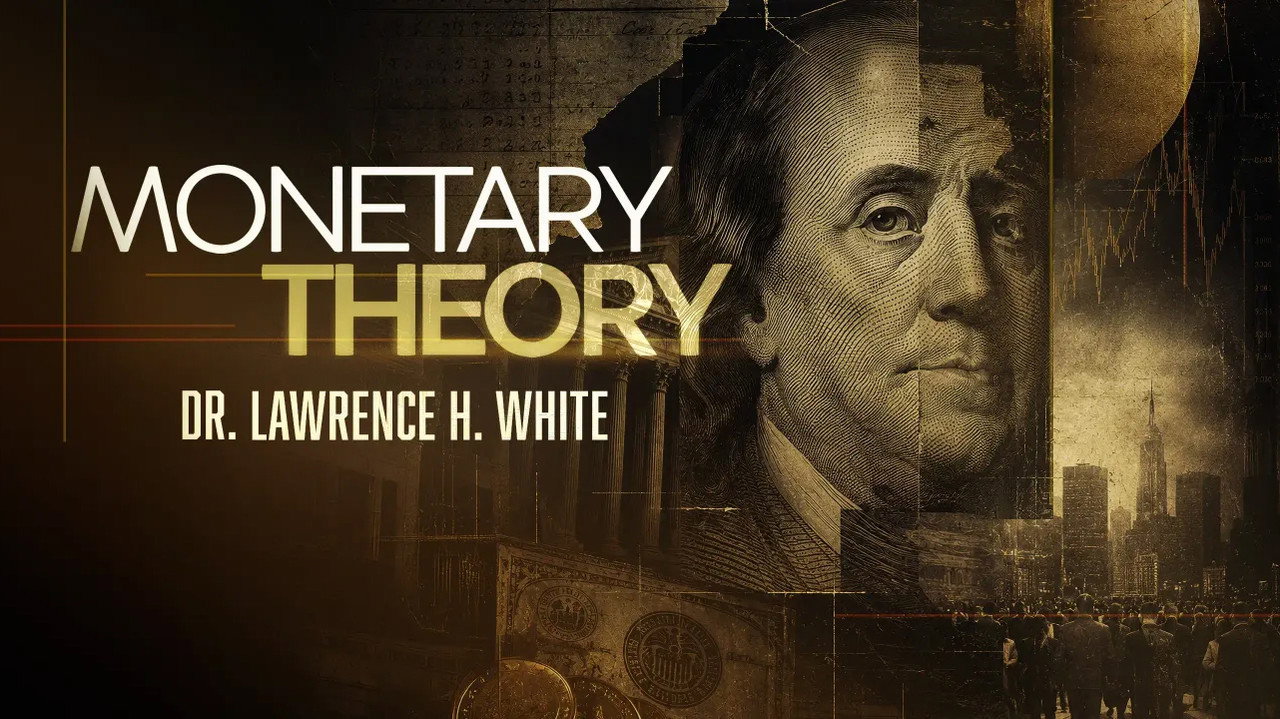
Monetary Theory

Monetary Theory

Ended First aired 03/Mar/2026 United States English 1 season(s) 8 episode(s)
In Monetary Theory, a nine-hour course, Dr. Lawrence White explores the debate between market-based and government-controlled monetary systems, combining theory with historical evidence from gold standards to modern fiat currencies. We examine how money can emerge through market forces, the mechanics of fractional-reserve banking, and how central banks influence inflation. The course also addresses banking stability, market failure arguments, and the causes of inflation, including seigniorage. It concludes by evaluating monetary policy rules, inflation targeting, and alternatives like Bitcoin, and asks whether sound money requires commodity backing or if proper institutional design can achieve stability in fiat systems.

Episode Time in Your Timezone

See when new episodes air in your local time.

Air Time

Source: UTC · Your timezone: America/New_York

When does the episode air near you?

The local release time is not available yet because this show has no schedule time.


Notice: Schedule time is not available yet.

Show Insights

See how viewers feel about this show before you start watching.

TimeScore 33% Skip It
Binge Meter 48% Slow Burn
Episode Pulse Quiet 40% activity score
Drop Rate 0% Very Low

Scores are based on audience votes, watchlist activity, episode progress, and viewer behavior on EpisodeTime.

Seasons & Episodes

Browse episodes by season.

Season 1 · Course 1
8 episode(s) · Air date: 03/Mar/2026
Improve Season
Season Overview

--

S1E8
How to Secure Better Money
Air date: 03/Mar/2026 · Runtime: 70 min
Summary

In our eighth and final lecture, we discuss the challenges of maintaining sound money in a fiat monetary system and examine potential solutions to prevent fiscal problems from undermining the dollar's purchasing power. We delve into the debate over central bank rules versus discretion, analyzing why monetary policy cannot permanently reduce unemployment or boost real economic growth. Dr. White concludes our course by evaluating various monetary policy targets, including inflation targeting versus nominal GDP targeting, and considers alternative approaches such as Hayek's proposal for competitive currencies and the potential role of Bitcoin as a monetary standard.


Summary

In our eighth and final lecture, we discuss the challenges of maintaining sound money in a fiat monetary system and examine potential solutions to prevent fiscal problems from undermining the dollar's purchasing power. We delve into the debate over central bank rules versus discretion, analyzing why monetary policy cannot permanently reduce unemployment or boost real economic growth. Dr. White concludes our course by evaluating various monetary policy targets, including inflation targeting versus nominal GDP targeting, and considers alternative approaches such as Hayek's proposal for competitive currencies and the potential role of Bitcoin as a monetary standard.

S1E7
Money Making
Air date: 03/Mar/2026 · Runtime: 66 min
Summary

In lecture seven, we study the underlying causes of money growth and inflation, examining why central banks issue more money than is consistent with stable purchasing power. We delve into the concept of seigniorage—the profit from money creation—tracing its historical roots from medieval mints that debased coins to modern fiat money systems where governments can finance spending by printing currency. The lecture analyzes how governments facing fiscal pressures, particularly during crises, may resort to excessive money printing, potentially leading to hyperinflation, and discusses the growing U.S. debt-to-GDP ratio and its implications for future monetary policy and inflation risk.

Summary

In lecture seven, we study the underlying causes of money growth and inflation, examining why central banks issue more money than is consistent with stable purchasing power. We delve into the concept of seigniorage—the profit from money creation—tracing its historical roots from medieval mints that debased coins to modern fiat money systems where governments can finance spending by printing currency. The lecture analyzes how governments facing fiscal pressures, particularly during crises, may resort to excessive money printing, potentially leading to hyperinflation, and discusses the growing U.S. debt-to-GDP ratio and its implications for future monetary policy and inflation risk.

S1E6
Bank Fragility
Air date: 03/Mar/2026 · Runtime: 66 min
Summary

In lecture six, we analyze arguments for government involvement in banking, particularly the claim that unrestricted banking is inherently unstable and prone to runs. We explore the Diamond-Dybvig model that justifies deposit insurance, contrasting random panic theories with "bad news" explanations for runs. Dr. White concludes that well-capitalized, diversified banking systems—like Canada’s—are stable, and that U.S. instability stemmed from legal restrictions, leading to the Federal Reserve as a political compromise rather than an economic necessity.

Summary

In lecture six, we analyze arguments for government involvement in banking, particularly the claim that unrestricted banking is inherently unstable and prone to runs. We explore the Diamond-Dybvig model that justifies deposit insurance, contrasting random panic theories with "bad news" explanations for runs. Dr. White concludes that well-capitalized, diversified banking systems—like Canada’s—are stable, and that U.S. instability stemmed from legal restrictions, leading to the Federal Reserve as a political compromise rather than an economic necessity.

S1E5
Government in Money
Air date: 03/Mar/2026 · Runtime: 65 min
Summary

In lecture five, we consider whether government intervention in monetary services improves public welfare, using concepts like market failure and Pareto efficiency. We evaluate public goods, externalities, and natural monopoly arguments, finding little support for intervention since money is largely rival and excludable, and network effects are typically internalized by markets. The lecture concludes with Friedman’s optimum quantity of money theory, which advocates mild deflation to reduce the cost of holding money and maximize welfare, though such policies have proven impractical in practice.

Summary

In lecture five, we consider whether government intervention in monetary services improves public welfare, using concepts like market failure and Pareto efficiency. We evaluate public goods, externalities, and natural monopoly arguments, finding little support for intervention since money is largely rival and excludable, and network effects are typically internalized by markets. The lecture concludes with Friedman’s optimum quantity of money theory, which advocates mild deflation to reduce the cost of holding money and maximize welfare, though such policies have proven impractical in practice.

S1E4
The Fiat Standard
Air date: 03/Mar/2026 · Runtime: 65 min
Summary

In lecture four, we explore fiat money—currency created by government decree rather than commodity backing—tracing its rise after wartime suspensions of the gold standard and the shift to central bank control of the money supply. We examine the quantity theory of money, showing that increases in money supply drive price levels and make central banks responsible for inflation. The lecture concludes that institutions like the Federal Reserve control inflation through monetary policy, challenging alternative explanations such as deficits or “greedflation” as primary causes of inflation.

Summary

In lecture four, we explore fiat money—currency created by government decree rather than commodity backing—tracing its rise after wartime suspensions of the gold standard and the shift to central bank control of the money supply. We examine the quantity theory of money, showing that increases in money supply drive price levels and make central banks responsible for inflation. The lecture concludes that institutions like the Federal Reserve control inflation through monetary policy, challenging alternative explanations such as deficits or “greedflation” as primary causes of inflation.

S1E3
Free Banking
Air date: 03/Mar/2026 · Runtime: 66 min
Summary

In lecture three, we examine banks’ role in issuing money under a gold standard, explaining why people prefer banking services to direct gold transactions and what constrains banks without legal limits. We explore fractional-reserve banking as a voluntary system where banks provide payments and interest while lending a portion of deposits. The lecture concludes by showing how market forces—adverse clearings, reserve losses, and the price-specie flow mechanism—naturally limit money creation, allowing competitive banking systems to self-regulate without central bank oversight.

Summary

In lecture three, we examine banks’ role in issuing money under a gold standard, explaining why people prefer banking services to direct gold transactions and what constrains banks without legal limits. We explore fractional-reserve banking as a voluntary system where banks provide payments and interest while lending a portion of deposits. The lecture concludes by showing how market forces—adverse clearings, reserve losses, and the price-specie flow mechanism—naturally limit money creation, allowing competitive banking systems to self-regulate without central bank oversight.

S1E2
The Gold Standard
Air date: 03/Mar/2026 · Runtime: 69 min
Summary

In lecture two, we learn about the mechanics of a gold standard, focusing on how supply and demand for monetary gold determine money’s quantity and purchasing power. Dr. White explains the system’s self-correcting mechanism, where changes in demand spur adjustments in gold mining, restoring equilibrium and supporting long-run price stability. Comparing gold and fiat systems, the lecture highlights historically lower inflation, greater price predictability, and stronger fiscal discipline under gold. Finally, we review common objections about gold resource costs and consider why economists today generally oppose returning to a gold standard.

Summary

In lecture two, we learn about the mechanics of a gold standard, focusing on how supply and demand for monetary gold determine money’s quantity and purchasing power. Dr. White explains the system’s self-correcting mechanism, where changes in demand spur adjustments in gold mining, restoring equilibrium and supporting long-run price stability. Comparing gold and fiat systems, the lecture highlights historically lower inflation, greater price predictability, and stronger fiscal discipline under gold. Finally, we review common objections about gold resource costs and consider why economists today generally oppose returning to a gold standard.

S1E1
Money: Private or Public?
Air date: 03/Mar/2026 · Runtime: 56 min
Summary

In our introductory lecture, Dr. White delves into monetary theory by examining the fundamental question of whether markets or governments should provide money, drawing on historical and theoretical perspectives on monetary systems. Together, we analyze Carl Menger's market theory of money, which explains how money emerges naturally from barter between individuals, contrasting this with the state theory that claims government intervention is necessary for monetary systems to function. Dr. White highlights 19th-century American private mints during gold rushes as evidence that market forces can produce trustworthy money without government involvement. Finally, we see that government monopolies often lead to debasement for revenue, and that private systems remain relevant to modern debates on digital currencies.

Summary

In our introductory lecture, Dr. White delves into monetary theory by examining the fundamental question of whether markets or governments should provide money, drawing on historical and theoretical perspectives on monetary systems. Together, we analyze Carl Menger's market theory of money, which explains how money emerges naturally from barter between individuals, contrasting this with the state theory that claims government intervention is necessary for monetary systems to function. Dr. White highlights 19th-century American private mints during gold rushes as evidence that market forces can produce trustworthy money without government involvement. Finally, we see that government monopolies often lead to debasement for revenue, and that private systems remain relevant to modern debates on digital currencies.

Cast

Main cast members.

Crew

Creators, directors, writers, and production crew.

Similar TV Shows

Community picks and smart matches based on genre, network, country, and language.

Smart picks

Suggest a Similar Show

Login to suggest similar TV shows.

User Reviews & Ratings

Audience score, review cards, votes, comments, and watch activity.

+ Review
0.0 0 review(s)
No ratings yet.
Watch Activity
Watching0
Completed0
Dropped0
Not Interested0
Watched Episode0
Season Rating Chart

Season Rating Chart

Average rating from all episode ratings in each season.

No episode ratings yet. Rate episodes below to build this chart.
Top Rated Episodes

Top Rated Episodes

Episodes ranked by audience rating.

No top episodes yet.
No reviews yet. Be the first to rate this show.
My Rating

My Rating

What did you think of Monetary Theory?

Login to Review